

Therefore We Are
Diving into the behavior of symbiotic organisms
A coral colony is a freak of nature.
Millions of tiny coral polyps form massive underwater reefs, but they couldn’t do it without their symbiotic algae partners and the bacteria and viruses that live among them.
Corals embody a host of conundrums for the scientific thinker. How do we define an individual “coral”? Where does one organism begin and another end? How do these creatures complicate our understanding of evolution, which traditionally views individual organisms as the unit of selection? What can corals teach us about other organisms where the whole is greater than the sum of its parts? Like, for example, humans.
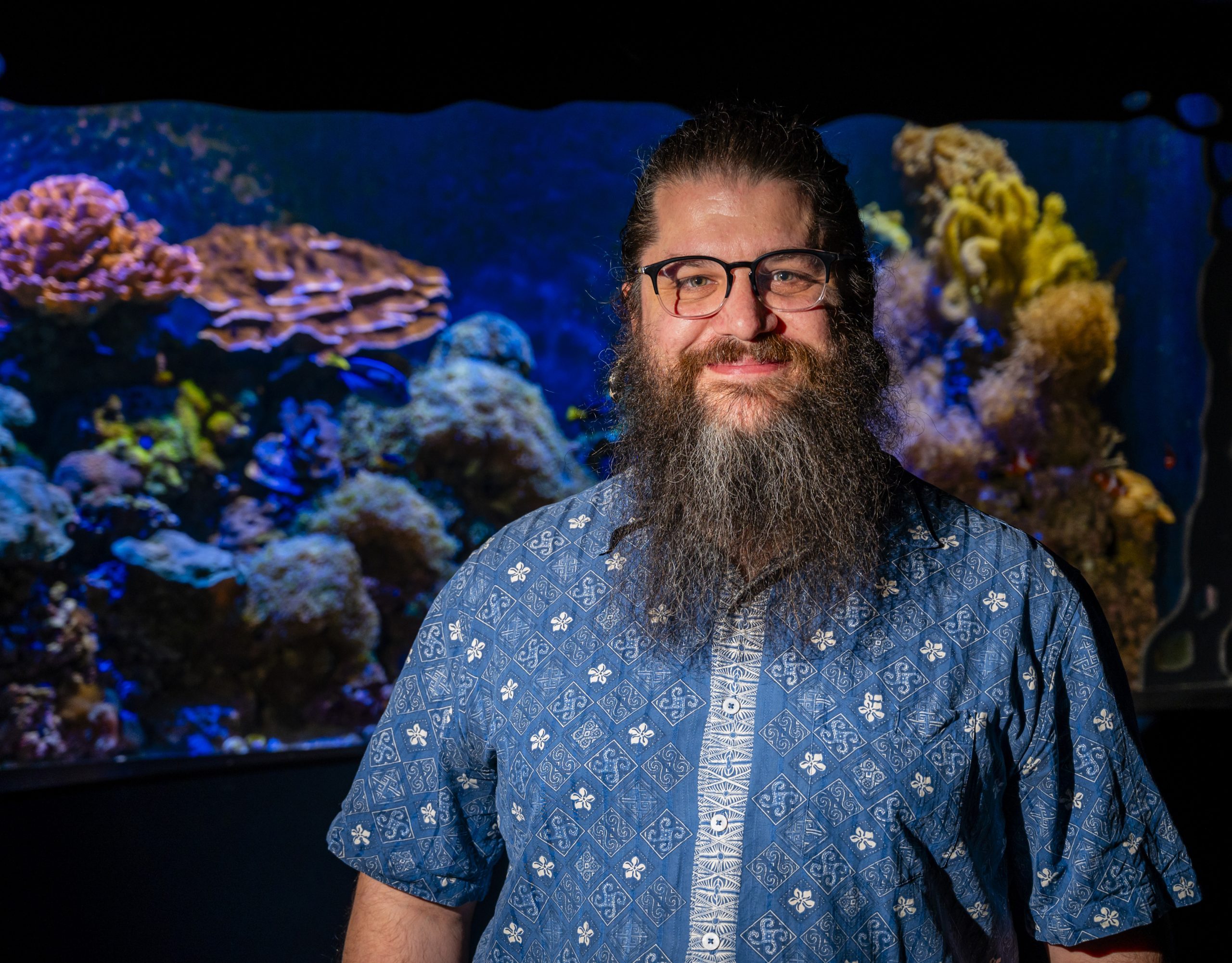
“I just love weird things that break our common notions about biology,” says Assistant Professor of Philosophy Derek Skillings, grinning through his jungly beard.
Dr. Skillings is the lead investigator on a new three-year, $600,000 grant from the John Templeton Foundation for a project entitled, “The Emergence and Evolution of Goal-Directed Behavior in Collective Entities.” It is the largest grant ever received by UNCG’s Department of Philosophy.
The grant is Skillings’ second from the Templeton Foundation. His first focused on understanding “the physiology, ecology, and evolution of holobiont systems.” ements. The technology is used in everything from local news to Disney productions such as The Mandalorian.
The Team in “I”
“A holobiont is a term for a host organism and all of the things that live inside of it and on it,” explains Skillings, who also holds adjunct positions in biology and in geography, environment, and sustainability.
“We used to think these weird things like corals, lichens, and maybe certain insects, which are amalgamations of symbioses, were the exception in nature. But now we are realizing no, actually, it’s probably everything. Everything is a holobiont.”
Skillings points to the bacteria in our guts and on our skin, even the mitochondria in our cells, as evidence that humans – like coral and cows – are holobionts. From one perspective, a human is a unified organism. From another, we are an ecosystem unto ourselves.
These concepts can impact how we think about human diet and health, a major focus of the first grant, as well as how we understand biological and ecological systems for conservation.
As with a coral reef, the complexity of the project requires different specialists. Skillings has assembled Dr. Ben Allen of Emmanuel College, Dr. Rory Smead of Northeastern University, and Dr. Patrick Forber of Tufts University to aid him in examining how collective entities like ant colonies, corals, or human societies, behave and evolve.
Allen is a mathematician who creates models to predict how cooperative behavior develops in groups. Smead is a philosopher who specializes in game theory and agent-based models derived from economics. Forber is a philosopher of biology who, together with Smead, has studied how spiteful behavior may have evolved in humans to foster group cooperation over time.
“We’ve found there is a really cool, similar set of problems between cooperative behavior in single populations and these multi-species interactions we find in holobionts,” Skillings says.

Division of Research & Engagement
UNC Greensboro
1601 MHRA Building
1111 Spring Garden Street
Greensboro, NC 27412